As of earlier this week Intel officially launched its range of Intel Core 2 Duo chips, the successor to the Core Duo range launched back in January. As with the previous Core Duo range, the Core 2 Duo processors aim to keep performance up while dropping power consumption and thus lowering heat production.
Although the Core 2 processors have already made it into notebooks and desktops for other manufacturers, the aim of this article is the future of Apple products with the new Core 2 Duo processor range.
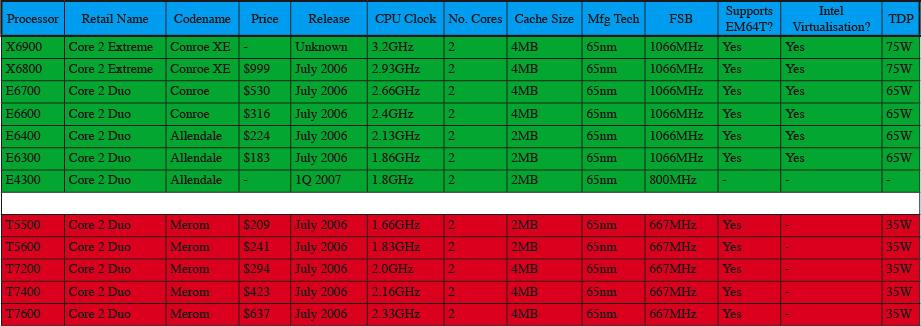
First of lets look at the table, its primarily broken into portable and desktop processors but as we know it is quite possible to use Desktop aimed processors in a notebook computer and if necessary the other way around.
The first column is the official name of the processor, although you may see it mentioned around forums and such, its not necessarily important to us onlookers. The second column is the moniker that the chips are sold under and as we all know from the hype, all these processors are sold under the Core 2 Duo brand. And thirdly is the Codename for the processor, now you will see this name mentioned a fair bit on forums and Intel press releases and roadmaps, its a good way for them to group together a bunch of similar processors rather than having to list the the full name of each chip.
Now we get onto the good stuff, the prices listed here is one that you'll see bounded about by the press, in detail it actually shows the price for direct Intel customers in 1000-unit tray quantities.
The next few columns are pretty obvious and go out of the range of this article, the release column naturally lists when the processor was either released or is going to be released, CPU clock lists the clock speed of the processor and Number of Cores lists how many cores the processor has and naturally all of these have 2. Next up is the Cache Size, in particular this refers to the L2 cache of each processor, in basic this is a small amount of low latency memory which stores copies of data from the most frequently used RAM locations, this reduces the time required to process instructions because instead of going to the RAM for the instruction the CPU can look in its own cache and receive it from there.
The Mfg Tech or Manufacturing Technology refers to the process in which the processor was made in, 90nm process became a big buzzword back in 2004 and many of us may remember the PPC G5 (970MP) using such technology. 90nm was also a big problem for fabrication plants as the process produced "leakage" which lead to increased power consumption and lots more heat. Now-a-days 65nm is the technology used, and was introduced on the Core Duo range earlier this year; 65nm appears to be quite successful as we can see from the Core 2 processors. The next milestone will be 45nm, which should arrive around about the middle of 2007.
The FSB or front-side bus refers to the speed of the main channel between the CPU and the chipset (either South or Northbridge), all other components such as AGP, PCI and the memory busses connect the chipset rather than the CPU itself.
The next two columns refer to two technologies that Intel are touting, first off is EM64T, in basic it allows the processor to understand 64-bit instructions and allows access to more than 4GB of virtual or physical memory. When Apple moved to Intel we took a slight step back as far as 64-bit goes, the PPC G5 was a 64-bit processor capable of understanding both 32 and 64-bit instructions but with the introduction of Intel Core this was gone and Macs were back to be being 32-bit only. With the introduction of Core 2 both notebooks and desktops will support 64-bit instruction sets, which is not necessarily going to impact the lower end models but it’s a good sign of things to come.
Secondly is Intel Virtualisation Technology, although this was featured in Intel Core, it is widely rumoured that is was disabled through the BIOS. The technology is yet to be used by Apple and it is unknown whether it ever will be, but it allows the processor to run multiple operating systems concurrently. Intel describes the technology as the follow:
Virtualization enhanced by Intel Virtualization Technology will allow a platform to run multiple operating systems and applications in independent partitions. With virtualization, one computer system can function as multiple “virtual” systems. With processor and I/O enhancements to Intel’s various platforms, Intel Virtualization Technology can improve the performance and robustness of today’s software-only virtual machine solutions.
Although the technology is there it doesn't necessarily mean Apple will take advantage of it.
Finally is the TDP, (Thermal Design Power) the main aim of TDP is to represent the maximum amount of power required by the processor. Although the TDP is a subject of discussion when it comes to the differentiation between how processor manufactures define the TDP. In particular Intel states that:
“Analysis indicates that real applications are unlikely to cause the processor to consume maximum power dissipation for sustained periods of time. Intel recommends that complete thermal solution designs target the Thermal Design Power (TDP) indicated in Table 26 instead of the maximum processor power consumption. The Thermal Monitor feature is intended to help protect the processor in the unlikely event that an application exceeds the TDP recommendation for a sustained period of time.”
Now we've looked at the table it's time to move on to how these processors could be placed in the Apple line-up.
Mac mini
Current Set-up
- 1.5 (Underclocked)GHz Intel Core Solo (T1300) retails for $599 (Processor price $209)
- 1.66GHz Intel Core Duo (T2300) retails for $799 (Processor price $241)
Potential Future Set-up
- 1.86GHz Core 2 Duo (E6300) retailing at $599 (Processor price $183)
- 2.13GHz Core 2 Duo (E6400) retailing at $799 (Processor price $224)
iMac
Current Set-up
- 17-inch 1.83GHz (T2400) retails for $1299 (Processor price $241)
- 20-inch 2.0GHz (T2500) retails $1699 (Processor price $294)
Potential Future Set-up
- 17-inch 2.4GHz (E6600) retailing for $1299 (Processor price £316)
- 20-inch 2.66GHz (E6700) retailing for $1799 (Processor price $530)
PowerMac (Mac Pro)
The Mac Pro is yet to be released but is slated for debut at WWDC next month. Both AppleInsider and Think Secret have put much speculation on the upcoming Mac Pro, ironically both sides are backing two different processors from Intel. Think Secret believes the Mac Pro will sport a new enclosure and pack Core 2 (Conroe) chips, which seems unlikely due to the inability for Conroe to be used in Dual Configurations (such as creating a Quad-Core machine).
AppleInsider believes that Woodcrest will be used in the future Mac Pro; this is more than likely as Woodcrest (Dual Core Xeon) is simply a Core 2 processor featuring SMP, which allows Dual Configurations.
In the very near future World of Apple will be giving a lowdown on Woodcrest, Clovertown, Harpertown and Tulsa and their relationship to the Mac Pro and Xserve.
MacBook Pro
Current Set-up
- 15.4-inch 2GHz (T2500) retailing for $1999 (Processor price $294)
- 15.4-inch 2.16GHz (T2600) retailing for $2499 (Processor price $423)
- 17-inch 2.16GHz (T2600) retailing for $2799 (Processor price $423)
Potential Future Set-up
- 15.4-inch 2GHz (T7200 Merom) retailing for $1999 (Processor price $294)
- 15.4-inch 2.16GHz (T7400 Merom) retailing for $2499 (Processor price $423)
- 17-inch 2.16GHz (T7400 Merom) retailing for $2799 (Processor price $423)
MacBook
Current Set-up
- 13-inch 1.83GHz (T2400) retailing for $1099 (Processor price $241)
- 13-inch 2.0GHz (T2500) retailing for $1299 (Processor price $294)
As we count down to WWDC, World of Apple will cover in more detail the potential configurations of the upcoming Mac Pro as well as the unreleased Intel Xserve.