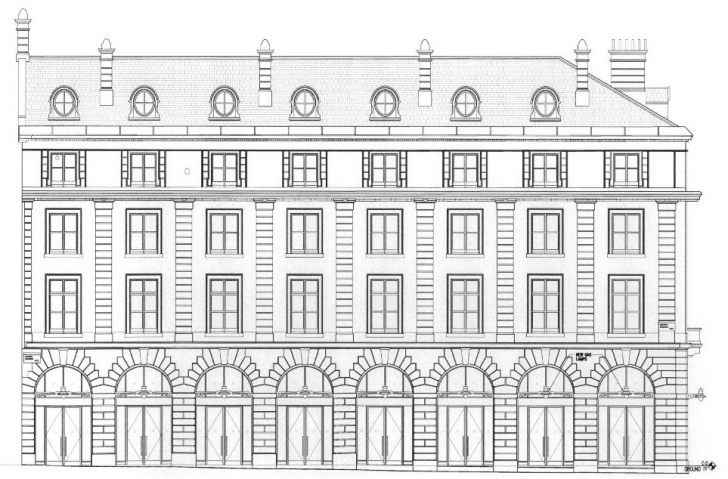
Every single square-inch of Apple's future Covent Garden (London) store has been replaced, repaired, restored or cleaned to prepare it for the millions of visitors who will step inside later this year and say, "Wow!"
The store, whose construction and restoration could cost over $30 million (£19 million), will be the city's fourth, and will have no rivals for its historic background, grand architecture and the loving restorative work by Apple's construction team. There have been just three other stores with any type of building history, but none as richly preserved and displayed as this one.
Much of the construction scaffolding has come down in front of the store over the past few weeks, revealing the façade. Inside, workers are finishing up construction that began 18 months ago.
First, the store's location in central London will reduce the huge crowds that the Regent Street store now experiences, and takes advantage of the millions of tourists who visit the city each year, most from countries that have no Apple stores.
Next, the location within central London is among the most historic and busy in the city. The building Apple will occupy dates to 1877, when gas lights and horse-drawn carriages traveled the cobblestone streets. It was designed and built by William Cubitt along one side of a huge courtyard, anchored in the center by a fruit and vegetable market that dates to the 13th century, and which had been rebuilt after a fire earlier in the 19th century.
Over decades, the Covent Garden Market commerce attracted many other businesses and, in turn, they attracted thousands of visitors, activity that continues today. On any weekend, the square that forms Covent Garden is packed with shoppers, gawkers, entertainers and passersby. During weekdays, the area is filled with people visiting offices, restaurants, theaters and museums. The market building continues to be an attraction for its businesses, but also for its history and architecture.
When visitors arrive at the completed Apple store, they will see a fully restored and renovated building. The red-brick and gray-stone façade of the building has been completely cleaned and repaired, bringing the color back to its original hue. Tall stone arches will frame massive doors set back under a arcade, and leading to ground floor retail space behind large windows. Signs with Apple's logo will be small and unobtrusive, and the original ornate gas lights along the outside have been restored and updated to modern electric standards.
Several windows on St. James Street have been restored to their original appearance. A ticketbooth added in more recent times has been removed. An original doorway on St. James Street has been modified and, just inside, a hallway has been created to allow stairway and elevator access to the upper-floor office space.
The interior is a mystery until the store's grand opening this summer. But photos of the original interior and architectural plans submitted to the city provide a view of the store's eventual magnificence.
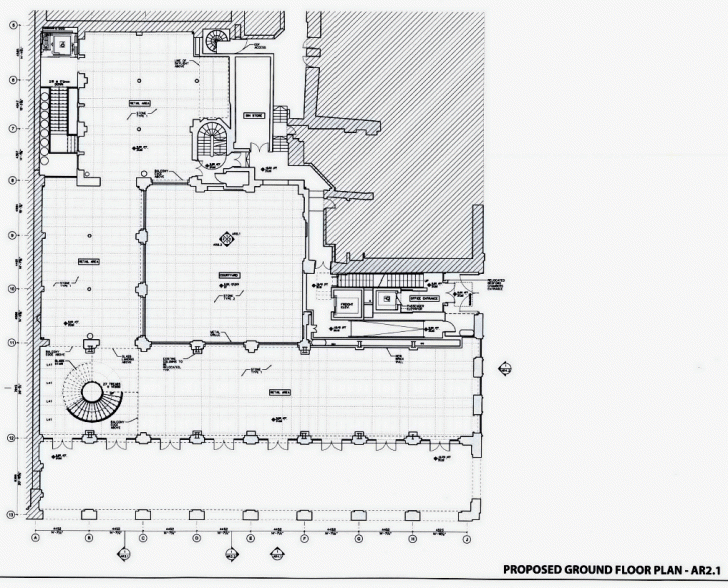
As you enter the store through one of the tall and ornate double doors, there will be a large, spiral-glass staircase on your left, rising to the mezzanine level. Product display tables are located on this level, leading from the staircase to the end of the building on your right.
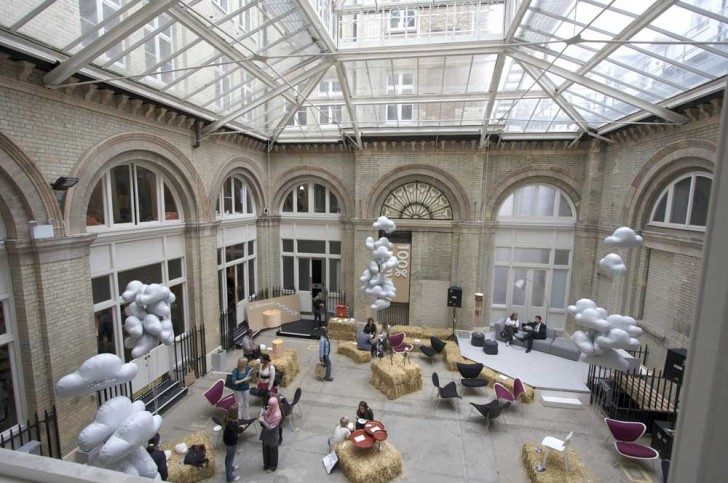
As you walk beyond those tables and to the rear of the store, the building's most spectacular feature is revealed with each step—a huge and luminous open space occupied by training tables, enclosed by medium-brown brick walls, stone arches, and topped with a wall-to-wall, modern glass skylight. A huge and elaborate iron gate fills one archway, while others are either bricked-over or lead to other spaces in the building. The 60'x60' space once attached to St. James street, and was used like a modern day loading dock for delivery carts and horse-drawn trucks.
Once you stop gazing upward, you'll notice that there is more retail space to one side of the courtyard, and beyond the courtyard to the rear of the building.
If you ascend the glass staircase, you'll find more product display tables, training spaces and the Genius Bar. You will also have a open view of the lower courtyard from two sides, and will be able to more closely examine the metalwork of the glass skylight.
A second staircase and elevator in the left-rear of the building will help take visitors between the ground-floor, mezzanine and part of the first-floor, which also has retail and training space.
What you won't see on a visit to the Apple store is that the company also occupies the entire basement of the building, and four upper floors. Those spaces will be used for retail offices and product inventory, and regional administrative offices and meeting rooms respectively.
Perhaps after a million visitors the Covent Garden store will become mundane, just another place to buy computers. More likely, it will become Apple's best example of how its modern retail stores can co-exist with history.
Gary Allen waited overnight for his first Apple store grand opening in Palo Alto (Calif.) back in 2001, met lots of interesting people, and has been hooked ever since. He posted a Web site devoted to Apple retail in 2003, and since then his coverage has included grand openings in the U.S., Japan, Australia, China, the UK, Italy and France. He finds that Apple enthusiasts are all the same around the world—passionate, creative and appreciative of their Apple gear. He's looking forward to grand openings in London, Paris, Chicago and Washington (DC) later this year.